
China Best Chaga Powder Supplier for Bulk Buyers?
Bulk buyers comparing suppliers in China need more than a low quoted price. Chaga Powder should be evaluated through species identification, processing details, traceability, and batch documentation. A polished sample is useful, but it cannot tell the whole story.
Mycologist Paul Stamets has called mushrooms “miniature pharmaceutical factories.” His observation concerns mushrooms broadly, not a guarantee about Chaga or any powder. For buyers, the practical lesson is to examine what each batch contains and how the supplier verifies it. Request the Latin species name, origin, processing method, and a recent certificate of analysis. Check whether testing covers identity, contaminants, and relevant quality specifications. Ask how samples compare with bulk production. Details matter.
A dependable supplier should answer clearly and provide records that match the offered lot. Compare particle size, moisture information, packaging, lead times, and minimum order quantities. Where applicable, confirm that stated quality standards are supported by current documentation. Do not treat attractive photographs or sweeping health claims as proof. Not every batch behaves alike. Even a careful review has limits: documents can be incomplete, and a sample may not represent a future shipment. That is a reason to ask better questions, not to assume bad faith. This guide outlines practical checks for assessing a China-based Chaga Powder supplier before making a bulk commitment.
What Is Chaga Powder and How Is It Produced?
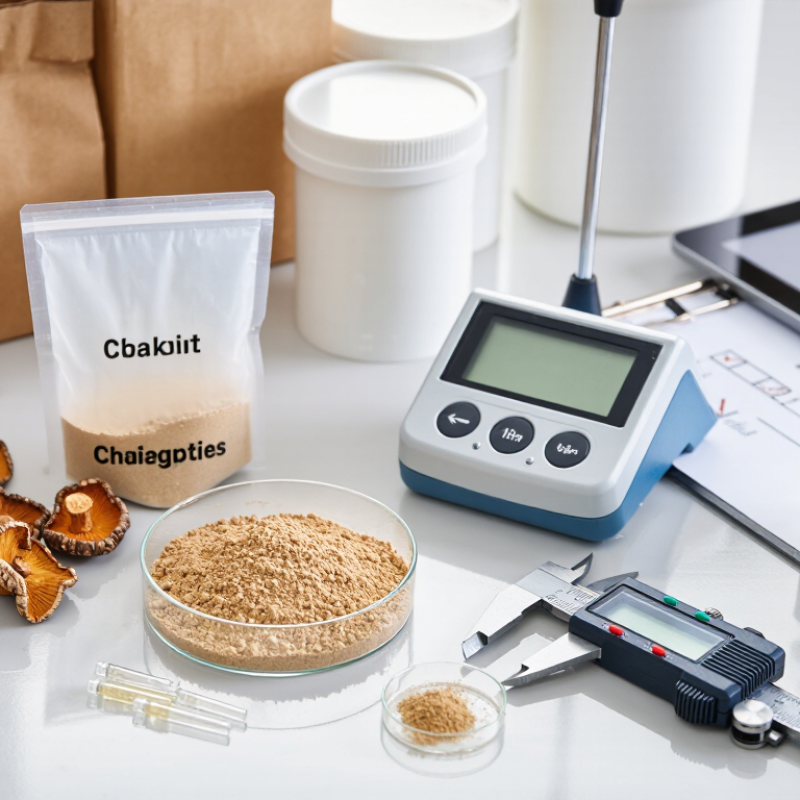
Chaga powder is made from Inonotus obliquus, a fungus that forms a dark, hardened growth on birch trees. It is not a cultivated mushroom cap. The material is collected, checked for species identity, and cleaned to remove bark and debris. It is then dried and milled into powder. Simple steps, but each affects the final product.
Drying should limit moisture without scorching the material; milling creates a fine, brown powder with a woody smell. Bulk buyers should ask for batch-specific identity, moisture, and contaminant testing, plus details on whether the product is plain powder or an extract. They are not interchangeable.
The raw-material story is less tidy than a label suggests: tree, location, harvest, and processing can all shape consistency. FAOSTAT recorded roughly 11.9 million tonnes of mushrooms and truffles worldwide in 2022, but that broad figure is not a Chaga supply estimate.
Not quite.
It does show why general mushroom statistics cannot verify a Chaga supplier’s capacity. Check the records behind the claims, not only the powder’s appearance.
What Should Bulk Buyers Look for in a Chaga Supplier?
Bulk buyers should look beyond a low price when assessing a Chaga powder supplier. Ask for the declared species, country of origin, and harvest details. Chaga is commonly identified as Inonotus obliquus, but clear identification still matters. Request recent, lot-specific test reports, not a generic certificate. Check whether tests cover heavy metals, microbial quality, and pesticide residues, and confirm which methods were used. Details matter.
Consistency is practical, not just a marketing claim. Compare samples from separate batches for color, aroma, particle size, and moisture information. A fine, dark powder may look uniform, yet appearance cannot verify composition or safety. Ask how the supplier controls drying, milling, and storage. Request packaging specifications too; moisture-resistant liners can help protect bulk material during shipping and warehousing. Ask for records.
Reliable communication is part of supplier quality. A capable supplier should explain lead times, minimum order quantities, batch traceability, and how they handle a failed specification. Get agreed limits in writing before placing a large order. No checklist removes every risk; paperwork can look tidy while a sample varies. That is worth remembering. If possible, review a pre-shipment sample and compare it with the approved reference, while recognizing that sampling cannot represent every unit in a shipment.
How to Assess Chinese Chaga Powder Suppliers
Assessing Chinese chaga powder suppliers takes more than comparing price lists. Ask for the Latin species name, country and region of harvest, and a clear description of whether the powder is whole-mushroom or extract. These details matter. A low price means little if the material or processing method is unclear.
Request a recent, batch-specific certificate of analysis. Check that it identifies the tested lot and reports relevant results, such as identity, moisture, microbiological quality, and heavy metals. Ask which laboratory performed the tests and whether you can verify the report directly. Good documentation should connect the sample, production batch, and shipment. It should not be a generic PDF with missing dates. If possible, arrange independent testing before a large order.
Also examine traceability and production controls. Ask how raw material is inspected, dried, milled, and protected from moisture. A supplier should explain its quality system plainly, not hide behind polished sales language. Review a sample for color, odor, texture, and consistency, then compare it with the agreed specification. Samples can mislead, though; one good pouch does not prove every batch will match. I would treat responsiveness as useful evidence, not proof of quality. Ask difficult questions, keep written records, and confirm inspection terms before paying.
Which Quality and Compliance Standards Matter?
For bulk Chaga powder, verify identity, traceability, and batch consistency—not just a polished certificate of analysis. The WHO’s 2019 Global Report on Traditional and Complementary Medicine found that 170 of 194 Member States reported use of these practices. That figure signals broad interest, not product approval. Buyers still need evidence for the specific lot.
WHO’s Quality Control Methods for Herbal Materials recommends checks for identity, foreign matter, moisture, ash, and contaminants. Ask suppliers for test methods and results covering microbial counts, heavy metals, pesticides, and active-compound markers. ISO/IEC 17025 accreditation helps show that a laboratory is competent; it does not guarantee every test is relevant. A clean COA is reassuring, but I would still question vague methods and missing batch numbers. Standards can also differ by destination market.
Tips: Request a retained sample and compare its color, aroma, and grind with the next shipment. Confirm that the botanical name, origin, and production date match across labels and records. Small discrepancies matter.
How Do Bulk Orders, Pricing, and Shipping Work?
For bulk chaga powder, request a tiered quote for sample, 25-kilogram, and pallet quantities. Compare the price per usable kilogram, not just the headline price. Ask whether milling, moisture testing, packaging, and export documents are included. A low quote can become costly if the powder needs finer grinding or arrives in oversized sacks. Small details matter.
Before confirming an order, request a lot-specific certificate of analysis. Check the test date, identity method, moisture, and results for microbial contamination and heavy metals. Ask for the harvest or raw-material origin and a retained-sample policy. These checks do not guarantee quality, but they make supplier claims easier to evaluate. I would not rely on a generic certificate alone.
Shipping costs depend on weight, destination, packing format, and delivery terms. Get separate estimates for air and sea freight, and confirm who handles customs paperwork and any destination charges. UNCTAD’s Review of Maritime Transport 2024 reported maritime trade volume growth of 2.4% in 2023 and forecast 2.7% for 2024, while noting disruption-related pressure on shipping routes. That broader data cannot predict a chaga shipment’s cost. Request a dated freight quote, confirm the dispatch window, and leave room for delays. Forecasts are not guarantees.
